

Gyratory Crushers
Apr 25, 2023
Leave a message
Essentially, the gyratory crusher The crushing apparatus features a sturdy frame made of heavy cast-iron or steel. It comprises a lower section with an actuating mechanism consisting of eccentric and driving gears, and an upper section with a cone-shaped crushing chamber. The chamber is lined with wear-resistant plates known as concaves. A steady-rest, known as a spider, stretches across the top of the crushing chamber. It contains a precisely machined journal that secures the position of the upper part of the main shaft. The main shaft is the active part responsible for crushing and is accompanied by a crushing head or head center and mantle. This assembly is hung in the spider journal using a substantial nut, allowing for vertical adjustment of the shaft and head in most machines, except the very large ones. The lower end of the main shaft passes through the babbitted eccentric journal, which offsets its position with respect to the centerline of the crusher.
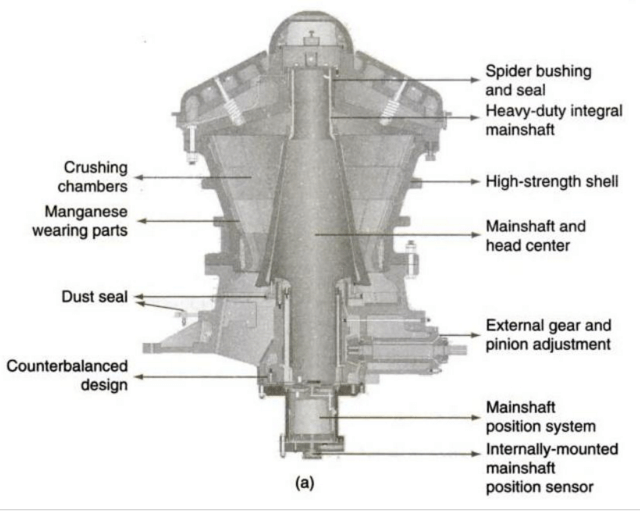
As the gear train rotates the eccentric, it results in the gyrating motion of the lower end of the main shaft in a small circular path. Consequently, the crushing head also gyrates within the crushing chamber, gradually moving closer to, and then further away from, every element of the cone-shaped inner surface. Through this motion, the crushing process is achieved effectively and efficiently, ensuring that all particles are finely crushed.

The action of the gyratory crusherThe jaw crusher, belonging to the reciprocating pressure family, is simply designed yet incorporates extensive engineering to optimize crushing chambers. These enhancements aim to increase capacities and allow for closer discharge settings, particularly for secondary and fine reduction crushing. Various crusher types have undergone progressive design improvements to achieve these objectives.
The manufacturer's table provides information on the available sizes and capacities for standard gyratory crushers. These crushers are available in sizes ranging from 8" to 60" for different receiving openings. The capacities are listed in short tons per hour for both minimum and maximum open-side discharge settings. Additionally, the horsepower requirements are also listed for each size concerning both soft and hard materials. It is important to note that the capacities and minimum settings are based on the use of standard concaves that have a straight-face design.

Primary gyratory crushersCrushers are identified by two numbers; the first number represents the size of the feed opening in inches, while the second number indicates the diameter of the mantle base, also in inches. For instance, a 60" x 89" crusher means that it has a 60-inch (152 cm) feed opening and a base diameter of 89 inches (226 cm).

In order to withstand the rugged demands of breaking down hard and stubborn rocks and ores while maintaining proper alignment, the crusher must possess massive and sturdy proportions, where rigidity is just as vital as strength. Irrespective of the metal's tensile strength used for the main frame, top shell, and spider, these components must be constructed with thick walls and ribs to ensure the required inflexibility. Consequently, utilizing close-grained cast iron or specialized high-test mixtures of cast iron becomes feasible for such parts when the machine is designed for crushing materials of soft or medium hardness. However, when dealing with exceptionally durable and resilient materials, incorporating cast steel into one or multiple parts becomes customary to reinforce the machine's structure.
Wearing parts in the